We have all experienced the frustration of relying on a seasoned workplace expert for critical guidance, only to receive a 200-page technical manual or a wave of hand-waving accompanied by, “You just have to know.” Instead of actionable instructions, learning teams are routinely left with abstract policies or dense slides that fail to explain how high-stakes decisions are actually made on the job.
This disconnect points to a fundamental operational reality: true competence lives in subconscious “tacit knowledge” rather than explicit documentation. Bridging the gap between an expert’s deep domain mastery and effective organizational learning requires deliberate diagnostic frameworks and structured elicitation techniques, rather than generic stakeholder management advice.
Top Performers Secretly Forget Up to 71% of What They Do)
When professionals achieve elite status, their execution becomes automatic, a cognitive phenomenon known as “Automated Mastery.” Because complex decision-making shifts to a subconscious level, experts systematically skip essential foundational steps and decision points when attempting to instruct novices.
This is not a lack of effort or goodwill; it is a documented cognitive limitation. A landmark cognitive task analysis study by Sullivan et al. (2014) examining expert surgeons teaching technical procedural skills revealed that the experts omitted 71% of critical clinical steps and 73% of key decision-making criteria from their instruction. Top performers simply do not know what they do not know about their own internalized routines.
When domain experts struggle to share their know-how, they are blocked by three specific cognitive barriers:
- The Omission Gap (Automated Mastery): Experts execute complex workflows subconsciously, routinely leaving out fundamental steps because they no longer realize they are performing them.
- The Curse of Knowledge: High proficiency makes it exceptionally difficult for experts to simulate the mindset of a beginner, leading them to underestimate the time, cognitive load, and step-by-step scaffolding a novice requires.
- Over-Abstraction: Experienced practitioners think in high-level conceptual frameworks rather than sequential actions, defaulting to broad theoretical rules when learners require concrete, operational mechanics.
As philosopher Michael Polanyi famously observed:
“We can know more than we can tell.”
Because experts inherently know more than they can articulate, learning professionals cannot simply transcribe what an expert says. They must deploy structured diagnostic and extraction protocols to uncover the critical steps experts forget to mention.
Stop Treating Every SME the Same (The Presence & Transfer Grid™)
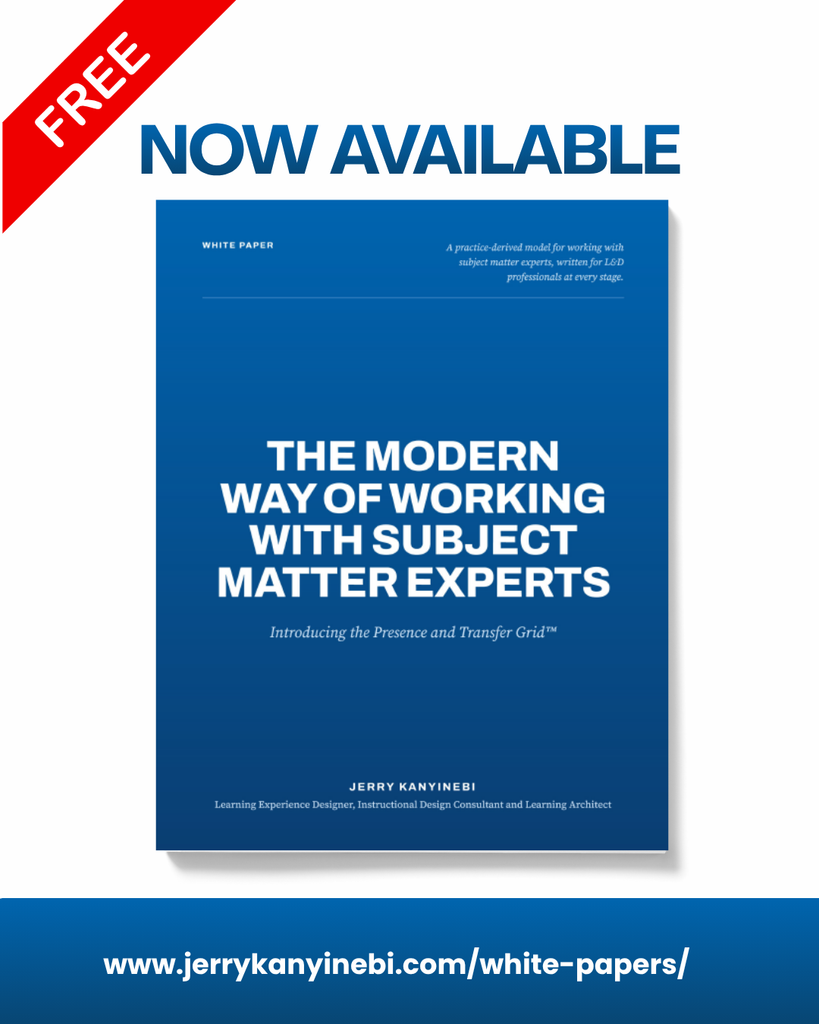
Most workplace learning strategies treat every subject matter expert (SME) as a single personality type, relying on vague advice like “building rapport.” However, effective collaboration depends on diagnosing the expert across two operational dimensions created by learning architect Jerry Kanyinebi:
Presence (whether you collaborate with them directly as a live partner or indirectly through published work) and Transferability (whether their knowledge is locked as a “Keeper” or easily articulated as a “Translator”).
Crucially, the Presence & Transfer Grid™ is an operational diagnostic, not a personal judgment. An expert’s profile is not permanent; a specialist may act as a Keeper on complex technical architecture but function as a Translator on basic operational routines. Furthermore, profiles evolve over time—with structured elicitation support, a Keeper can gradually develop into a capable Translator across project cycles.
Mapping these two dimensions yields four distinct SME profiles:
- Direct Presence (Live Project Partners)
- Direct Keeper [DRAW OUT]: A live project partner possessing deep tacit mastery who struggles to articulate their step-by-step process, often defaulting to dense jargon, abstract theory, or statements like “you just know.”
- Direct Translator [CO-CREATE]: A live project partner who is an articulate, natural mentor, capable of providing clear real-world examples, anticipating novice hurdles, and co-designing practical scenarios.
- Indirect Presence (Published & Codified Sources)
- Indirect Keeper [UNPACK]: Authoritative, highly technical published materials—such as regulatory filings, ISO standards, or clinical research—that contain critical facts but are dense, abstract, and difficult to digest.
- Indirect Translator [ADAPT & VERIFY]: Clear external media, such as practitioner podcasts, video tutorials, or case studies, that explain concepts accessibly but require verification for technical accuracy and contextual fit.
Applying an approach designed for an articulate field mentor to a dense technical specialist wastes weeks of project time. Recognizing which quadrant an expert occupies dictates the exact interview strategy, review cadence, and design boundary needed to extract actionable knowledge.
Once you identify a Keeper on the grid, relying on standard interview formats will fail—requiring an immediate shift in questioning technique.
Never Ask an Expert an Abstract Question
Asking a Keeper open-ended, theoretical questions like “How do you assess risk?” or “What is your decision process?” inevitably backfires. Confronted with abstract prompts, experts default to high-level platitudes, official policy statements, or broad concepts that offer zero operational value to a learner.
The solution is to anchor interviews in concrete past events using the Critical Decision Method (CDM). Instead of discussing theoretical scenarios, force the expert to walk through a specific, real-life incident.
For example, replace broad open-ended prompts with a targeted CDM interview question:
“Tell me about the last project where a risk model failed. What subtle signal did you notice first? What did you check next?”
By anchoring the interview in a tangible event, you force the expert out of high-level theory and systematically draw out their granular decision pathways, implicit cues, and real-world troubleshooting steps.
To capture the complete operational picture, CDM interviews should be paired with visual follow-up protocols:
- Teachback Protocols: After drafting an initial workflow from a CDM interview, reflect it back to the expert visually: “Here is my understanding of your five-step diagnostic flow. Where is my logic wrong?” Experts who struggle to explain a process from scratch can instantly spot inaccuracies in a visual model.
- Task Observation and Work Logs: Supplement verbal interviews by watching the expert execute live tasks, reviewing their actual work logs, or analyzing past case files to surface the subconscious micro-steps omitted during conversation.
The Rising Threat of “AI Slop” and Synthetic Experts
When projects lack direct access to live experts, learning teams frequently turn to secondary external sources like online video tutorials, industry articles, and white papers. However, relying on indirect sources has become increasingly hazardous due to the proliferation of generative AI content, where professional authority can easily be manufactured.
Recent research underscores the scale of synthetic authority on public platforms:
- A 2025 study by Kapwing revealed that over 20% of the first 500 suggested YouTube videos for new accounts consisted of low-grade, AI-generated synthetic content.
- A 2025 evaluation of online biomedical science educational media published in PMC identified that roughly 5% of surveyed educational videos on YouTube and TikTok were low-quality AI outputs containing conceptual errors capable of misleading learners and instructors.
To safeguard content integrity, instructional designers must spot the red flags of synthetic authority before citing secondary sources:
- Epistemic Trespassing: Highly accomplished individuals pontificating on complex domains outside their verified field of competence.
- Volume Spikes: Channels or websites that appeared recently and publish an industrial volume of content impossible for human experts to sustain.
- Anonymous Authorship: Articles or media published without trackable individual or institutional credentials.
- Undisclosed Commercial Incentives: Media masking commercial product promotion as objective technical guidance.
To combat these risks, learning professionals must abandon “vertical reading” (evaluating credibility merely by scrolling through the author’s own site) and adopt Lateral Reading. Practiced by professional fact-checkers, lateral reading involves immediately opening new browser tabs to research what independent bodies, peer reviews, and outside credentials say about the author before trusting their authority.
Once indirect sources and human inputs are verified, learning teams must establish clear operational rules for how generative AI tools process this raw material safely.
Draw “The Judgment Line™” to Keep AI in Its Place
Generative AI tools can dramatically accelerate instructional design workflows, but deploying them without strict boundaries introduces severe compliance, technical, and institutional risks. Establishing an explicit operational boundary is an imperative for maintaining content integrity and ensuring human oversight where judgment matters most.
Organizations should implement The Judgment Line™, a framework dividing workflow tasks across three distinct zones:
- Zone 1 (AI Leads): Administrative and processing tasks, such as transcribing audio and video recordings, generating initial interview question banks for human review, and synthesizing raw meeting notes into categorized themes.
- Zone 2 (AI Drafts; Humans Verify): Structural drafting tasks that require strict validation, such as condensing dense technical manuals into plain-language summaries or drafting initial scenario prompts from validated transcripts. Rule: Every output must be cross-referenced and verified against primary source documents.
- Zone 3 (Human Ownership Only): Critical relationship, contextual, and oversight tasks that must remain human, including establishing professional trust with experts, reading subtle hesitations and implicit cues during interviews, evaluating real-world field constraints, resolving disagreements between technical leads, and signing off on final technical accuracy and legal compliance.
To enforce The Judgment Line™ effectively, organizations must mandate two foundational safeguards:
- AI Is an Assistant, Never an SME: Large language models generate plausible language sequences, not verified operational facts. Every LLM-generated guideline, scenario rule, or calculation must trace directly back to a verified human expert or primary institutional document.
- Confidentiality and Data Governance: Expert interviews and technical documentation frequently contain proprietary workflows, unreleased product specs, or sensitive client data. Never paste un-anonymized interview transcripts or confidential operating manuals into public commercial AI models.
Unlocking What Experts Can’t Tell Us
High-impact learning and performance support cannot be built on surface-level documentation or generic policy manuals. Capturing the vital, tacit judgment that separates top performers from novices requires diagnostic frameworks that meet experts where they are, isolate synthetic noise, and systematically draw out hard-won field experience.
Take a close look at your organization’s current critical learning initiatives: How are you systematically capturing hidden expert judgment before your top performers walk out the door?